
'Citing an example of the pressure students face, she mentioned that one student shared how friends in college would say, "Don't come back without that multi-crore job," as they said their goodbyes.' 'But you have to understand that this is the end of the beginning, and it's not even the beginning of the end.'

India will need to grow at an average 7.8 per cent to become a high-income country by 2047, a World Bank report said on Friday. To achieve this goal India would require reforms in financial sector as well as in land and labour market, the World Bank said in its India Country Memorandum titled 'Becoming a High-Income Economy in a generation'.
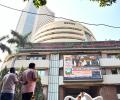
'BSE has facilitated nearly Rs 35 trillion in capital raising across multiple segments.'
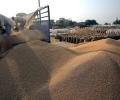
T Nanda Kumar, former food and agriculture secretary, shared his memories of working with former prime minister Manmohan Singh during some of India's most challenging times, highlighting Singh's compassionate leadership and commitment to ensuring food security for all Indians. Kumar recalled Singh's steadfast support during the 2008 global food crisis, where he championed a ban on non-basmati rice exports to secure domestic supplies. Singh's leadership, characterized by intellect and humility, left a lasting impression on Kumar, who considered him a mentor and guiding light.

India was not the only country that embraced the 'import-substituting industrialisation' fad.

India's economic reforms are the subject of a three-day conference at the Stanford University in USA from June six, with several Indian experts being among the participants.
With China emerging as the second largest economy after overtaking Japan, the ruling Chinese Communist Party made a surprise promise to loosen its firm grip on power structure saying that the gains made out of the economic reform would be lost without political reforms.

Speaking at a roadshow in Frankfurt on investment opportunities in India on Monday, the Minister said the economy was on the right path to achieve growth levels recorded during 2004-2008.
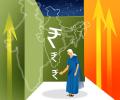
S&P Global Ratings on Wednesday upgraded India's sovereign rating outlook to positive from stable while retaining the rating at 'BBB-' on robust growth and improved quality of government expenditure. S&P said it could upgrade India's sovereign rating in the next 2 years if the country adopts a cautious fiscal and monetary policy that diminishes the government's elevated debt and interest burden while bolstering economic resilience.
India's economic growth during 2011-12 slipped to nine-year low of 6.5 per cent and during the first quarter of the current fiscal it was 5.5 per cent.
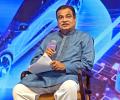
'I am not an aspiration-oriented politician.' 'This is the time to redefine politics.' 'Politics of power is not real politics.'

China is set to build a rail link connecting Xinjiang province with Tibet, part of which will run near the Line of Actual Control (LAC) with India.
Recent measures by Indian government to push economic reforms have dispelled fears of policy paralysis, while some more steps are needed for reviving investments and ensuring that household savings go into productive sectors, top banker Chanda Kochhar said.
There is a requirement for a fresh push, especially in agriculture, education and health which would deliver the inclusive growth -- the target of policy.

Kant, a retired 1980-batch Indian Administrative Service (IAS) officer of Kerala cadre, was appointed as India's G20 Sherpa in July 2022, months before India assumed the G20 Presidency.
The debate on whether economic reforms and accelerated economic growth have led to faster reduction in poverty levels and employment growth continues to generate disagreement.

'They mean business, but business as usual is unacceptable to them'
Expressing commitment to push forward economic reforms, Finance Minister Pranab Mukherjee today said the government is making efforts to build a consensus on important economic legislations, including PFRDA and foreign investment in multi-brand retail.

Foreign investors continue to exhibit confidence in the country's equity market, injecting Rs 19,860 crore in May driven by favourable global economic indicators and strong domestic fundamentals. This positive momentum follows a net investment of Rs 4,223 crore in April, data with the depositories showed.
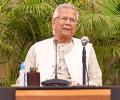
The chief adviser's decision to stay in office came two days after he told student-led National Citizen Party (NCP) leaders that he was mulling resignation as he felt "the situation is such that he cannot work", citing difficulties in working amid the failure of political parties to find common ground for change.
The Congress president rejected suggestions about any threat to the UPA coalition due to the frequent pressure from the Left on various issues and maintained that the party-led government faced 'no serious problem' so far.
Commenting on economic reforms, he claimed that accord is necessary to achieve these objectives in India.

From a hard core Leftist in the late 1960s to being the liberal face, Palaniappan Chidambaram combines in him the qualities of a bold reformer, experienced administrator and a taskmaster in whatever assignment is given to him.
Exudes confidence that RBI's rate cut move will revive investments and business sentiment; India to get $6.25-bn ADB assistance over three years

Broad convergence on GST rollout in NDC meet.
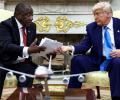
South African President Cyril Ramaphosa, a former anti-apartheid activist and freedom fighter, responded to Trump's claims at their meeting in the Oval Office diplomatically, countering Trump's assertions.

The CBI successfully managed to get Monika Kapoor extradited from the United States, ending her 25-year flight from justice. She is accused of economic offenses including forgery and fraud.
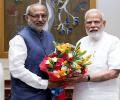
By naming a sworn swayamsevak for vice president, the Modi-Shah duo have sent out a clear and positive message to Nagpur, where the RSS headquarters is located, explains N Sathiya Moorthy.

Infosys chief Kris Gopalakrishnan on Wednesday expressed hope that DTC and GST will be pushed through in the forthcoming budget, while Genpact vice chairman Pramod Bhasin feared economic reforms will be tough going forward.
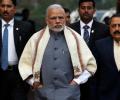
If the Modi government's approach to economic policy making is any indication, expectations of a sudden spurt in economic reforms after the assembly election results appear to be grossly misplaced.
India is fielding a 100-member team, led by Commerce Minister Kamal Nath and Planning Commission Deputy Chairman Montek Singh Ahluwalia. The duo will address a number of India-centric sessions on economic reforms.
Prime Minister Manmohan Singh would expedite action on implementing the long-awaited reforms in the banking, insurance and pension sectors once the government managed to win the trust vote in the Lok Sabha on Tuesday, government sources said on Saturday.

It is time for India to raise its voice not just through military prowess, but through professionalism, principled voting and partnerships, asserts Deepak Mishra.
Projecting a 7 per cent growth rate in 2005-06, government's pre-budget Economic Survey on Friday outlined reforms in tax and expenditure and labour laws as a priority in the budget.

N Chandrasekaran, chairman of Tata Consumer Products, has said in the company's annual report for FY25 that India remains one of the bright spots of economic growth amid a volatile global environment. He said India's long-term growth was underpinned by strong demographic and economic fundamentals as well as structural reforms.
